
-749.png)

Your listings are live, your budget is gone, and the applications are not coming. Before you spiral into an existential crisis about the state of the labor market, let Yobi walk you through what is actually going wrong — and how to fix it without losing your mind or your next paycheck.
By Yobi — The Recruiter's Honest Friend Who Will Not Let You Get Away With It
There is a particular kind of quiet that settles over a recruiter's dashboard when job ads go live and nothing happens. Not the peaceful kind of quiet, like a slow Sunday morning with good coffee. More like the quiet of a birthday party where you forgot to send the invitations. You have set everything up. The balloons are inflated. The food is ready. And you are standing there wondering why nobody showed up, when the answer is sitting in your sent folder — or rather, conspicuously absent from it.
This is the state of recruitment marketing for a lot of organizations in 2026, particularly here in the Philippines where the talent market has shifted significantly and the old playbook is showing its age badly. Whether you are running BPO recruitment, filling corporate roles in Metro Manila, managing regional hiring outside the capital, or trying to attract job applicants for a startup with a modest budget and aggressive targets, the fundamental problem is the same: the way most companies write and distribute job ads has not kept up with the way candidates now make decisions about where to work.
I want to be very specific in this article about what is going wrong and what you can do about it, because vague advice like "improve your candidate experience" helps no one. You need actual fixes. And before we get into those, I want to say something directly: the fact that you are reading this, the fact that you are trying to understand why your hiring strategies are not working and looking for ways to improve — that already puts you ahead of a lot of people who are still just boosting the same broken job ad for the fifth time and calling it a strategy.
Let us get into it.
72%
of candidates say a job ad's language affects whether they apply, regardless of the role itself
14 sec
Average time a candidate spends deciding whether to read further or move on from a job ad
60%
of applicants abandon applications that take longer than 20 minutes to complete
*
Let me tell you something that took me an embarrassingly long time to fully absorb: the person reading your job ad is not sitting in your office. They do not know your company culture, your team dynamics, your unspoken expectations, or what your hiring manager means when they say they need someone who is "a self-starter with strong communication skills." What they see is a list of requirements and a set of responsibilities that sound exactly like every other job ad they read that morning. And if nothing in your ad makes them feel something — curiosity, excitement, a sense that this role was written specifically for someone like them — they will click away without a second thought.
The root cause of this is almost always the same: the job ad was written by someone translating a hiring manager's internal requirements document into a public-facing post, without ever stopping to ask, "What does the ideal candidate actually need to hear to get interested?" The hiring manager wants someone with five years of experience in financial reporting. Fine. But the candidate wants to know if this job will challenge them, whether the team is competent, if the company is stable, and whether their work will actually matter to anyone. Those are two completely different conversations, and most job ads only ever have one of them.
This is especially critical in BPO recruitment, where the volume of listings is enormous and candidates have been burned enough times by misleading job ads that they read them with deep suspicion. If your listing looks like it was assembled from a template in under ten minutes, they know. They have seen enough of them. The ones that stop them mid-scroll are the ones that sound like a human being wrote them — someone who actually understands what the job is like and respects the candidate enough to be honest about it.
The fix here is less technical than it sounds. Before you write a single word of your next job ad, answer these three questions: Who is this person? What do they actually want from their next role? And why should they choose us over the other six ads they are looking at today? If you cannot answer all three, you are not ready to write the ad yet. Go back to your hiring manager, go back to your existing team members in similar roles, and find out. The fifteen minutes you spend on that research will do more for your attract job applicants rate than any amount of keyword optimization.
A job ad is not a job description with a nicer font. It is a pitch. You are selling a future to someone who has options. Write it like you know that.
*
I once saw a job ad — real, actual, posted publicly — with the title "Digital Ecosystem Growth Catalyst." I read it three times. I still do not know what the job was. I think it was a social media manager, but I genuinely cannot be certain. And here is the thing: neither could the candidates who were supposed to apply for it, which is probably why it sat empty for two months before they rewrote it as "Social Media Manager" and got thirty-seven applications in a week.
Job titles in job ads serve one primary function: they need to match what your ideal candidate is typing into a search bar at eleven in the evening when they are lying in bed reconsidering their career choices. That is it. That is the whole job of the job title. "Digital Ecosystem Growth Catalyst" is what you call someone at their company anniversary speech. "Social Media Manager" is what you put in a job ad. These are different documents with different audiences and different purposes, and confusing them is costing you applicants.
This matters enormously for recruitment marketing because job platforms — JobStreet, LinkedIn, Indeed, Kalibrr — surface listings based on keyword matching. If your title does not match the language candidates use to search, your ad simply does not appear. You could have the most beautifully written, perfectly structured, emotionally resonant job ad in the history of Philippine hiring, and it will generate zero applications because the algorithm never showed it to anyone. Creative titles live in your internal HR system. Searchable titles live in your job ads. Keep them separate.
Also worth examining: overly generic titles can hurt you just as much as overly creative ones. "Manager" tells a candidate nothing. "Customer Service Representative" in the context of BPO recruitment is so broad that candidates cannot tell if it is a match for their background without reading the entire listing — which, statistically, many of them will not do. Be specific. "Customer Service Representative – Healthcare Accounts" tells a candidate in five words whether this is worth their time. Specificity in job titles is one of the cheapest and most effective hiring strategies you have available, and most companies are leaving it on the table.
Yobi's blunt corner
If your job title sounds like it was invented by a branding consultant who has never actually done the job, delete it. Go to LinkedIn. Search for people who currently do what you are hiring for. Look at their job titles. Use those. You are not marketing a startup lifestyle. You are filling a seat. Call it what it is.
Alam mo naman 'to. You just needed someone to say it out loud.
*
Here is something that should be obvious but apparently still needs to be said: the candidate landscape in the Philippines in 2026 is not what it was five years ago. The platforms have changed. The behavior has changed. The expectations have changed. And yet a surprising number of companies are still operating their recruitment marketing the same way they always have — post on one or two job boards, wait, repeat — and then wondering why the results are different.
Let me be specific about what has changed. First, passive candidates — people who are employed and not actively job-hunting but would consider the right opportunity — now make up a larger portion of the available talent pool than ever before. These people are not refreshing JobStreet every morning. They are on LinkedIn, consuming content from their professional network. They are in Facebook groups specific to their industry. They are watching YouTube videos about career development. They are, occasionally, reading recruitment blog articles like this one. Reaching them requires content-driven recruitment marketing, not just listing distribution.
Second, mobile application behavior has fundamentally changed how candidates interact with job ads. More than sixty percent of job searches in Southeast Asia now happen on mobile devices, and the application experience on most company career pages is, to put it diplomatically, not optimized for this reality. Candidates who find your job ad on their phone and then encounter a career portal that was clearly designed for desktop use in 2012 will abandon the application. This is not laziness on their part. This is rational behavior in a world where they have ten other options a swipe away.
Third — and this is one that specifically affects BPO recruitment and high-volume hiring — the rise of messaging-based application pathways has created an expectation for faster, more conversational interactions. Candidates increasingly expect to be able to express interest and get a response quickly, not fill out a twelve-field form and wait three weeks. Companies that have adapted their hiring strategies to include WhatsApp or Viber touchpoints, chatbot pre-screening, or one-click apply with follow-up are seeing dramatically better top-of-funnel numbers than those still running everything through a traditional ATS portal alone.
None of this means you have to be everywhere at once, especially if you are a small team or a solo recruiter doing the work of four people. It means you need to know where your specific candidate pool actually is and be present there, rather than assuming they will find you through the same channels that worked in 2018. LinkedIn's 2026 talent trends research is worth reading in full on this point — the shift toward community-based talent discovery is accelerating faster than most recruiting functions have been able to keep up with.
*
I want to address the salary transparency question directly because I know it is complicated, and I know the reasons companies withhold it are not always as cynical as they appear from the outside. Sometimes it is a genuine policy decision. Sometimes it is because the range is wide and depends heavily on experience. Sometimes it is because your hiring manager has not actually decided on the budget yet, which is its own problem. Sometimes — and I say this with compassion — it is because the range is below market and you are hoping to get someone in the process before they find out.
Regardless of the reason, here is what the data consistently says: job ads with salary information receive more applications from more qualified candidates than those without it. This is true for entry-level roles, mid-level roles, and senior positions. It is true in Metro Manila, it is true in the provinces, and it is true in BPO recruitment where compensation benchmarks are well-known and candidates know exactly what the market looks like before they pick up the phone. The idea that withholding salary information gives you negotiating leverage is increasingly outdated — what it actually does is filter out the candidates who value their time enough to not engage with a process whose outcome is uncertain from the start.
Those are often the best candidates. The ones who know their worth and are selective about where they invest their energy. By hiding the salary, you are not keeping your options open — you are self-selecting for candidates who are either desperate enough to apply anyway, or inexperienced enough not to know that this is a red flag. Neither of those outcomes serves your hiring goals.
If you genuinely cannot post a specific number, post a range. If the range is wide, explain why briefly — "compensation varies based on experience and qualifications, ranging from X to Y." That is honest, it manages expectations, and it respects the candidate's intelligence. Glassdoor's research on salary transparency shows that this one change — adding a salary range to a listing — can increase application volume by a significant margin, particularly from candidates who are currently employed and evaluating whether a move is worth the disruption to their existing income.
Hiding your salary range does not make you mysterious and desirable. It makes you the person at the party who will not tell anyone what they do for a living. Eventually, people just stop asking.
*
There is a phenomenon in hiring that researchers have started calling "requirement inflation" — the tendency for job ads to accumulate requirements over time, often because each stakeholder involved in the hiring process adds their own wish list without anyone ever stepping back to ask whether all of it is actually necessary for the role. The result is a requirements section that would frighten a decorated veteran, attached to a role that is ultimately meant for a mid-level professional three years out of school.
I have seen job ads in the Philippines for fresh-graduate positions that list "minimum two to three years of experience" as a requirement, presumably written by someone who forgot that the phrase "fresh graduate" and "years of experience" are mutually exclusive. I have seen customer service roles that require fluency in three languages, advanced Excel skills, and familiarity with five specific software platforms — for a position that pays twenty-two thousand pesos a month. The math is not working, and the candidates can see it even if the recruiter cannot.
Requirement inflation hurts your attract job applicants numbers in two specific ways. First, it literally reduces the number of people who qualify — every additional requirement you add removes a portion of your candidate pool. Second, and more subtly, it signals to candidates that your company does not have a clear understanding of what the role actually demands, which raises questions about whether leadership is similarly unclear about other things. Candidates are making judgments about organizational competence from your job ads, even if they are not consciously aware of doing it.
The exercise I recommend to every recruiter I work with is this: go through your requirements list and mark each item as either "cannot do the job without this from day one" or "can be learned within the first three to six months with reasonable support." Keep the first category. Move everything from the second category to a "nice to have" section, or remove it entirely. What you are left with is your actual requirements list — and it is almost always significantly shorter than what you started with.
This matters even more for hiring strategies aimed at high-volume roles in BPO recruitment, where the talent pool is large but so is the competition. If your requirements list is more demanding than your competitor's for a comparable role at a comparable salary, candidates will choose the path of least resistance. They have options. Make it easy to say yes.
Relevant openings — for you or someone you know
*
Here is the thing about recruitment marketing that distinguishes it from general HR work: it is, at its core, a performance marketing function. Which means it should be treated the same way a good marketing team treats any campaign — with hypotheses, tests, measurements, and iterations. But most recruiting functions, particularly in mid-sized Philippine companies, do not operate this way. They post a job ad, wait to see what happens, and if the result is disappointing, they either boost the listing or post it again elsewhere without changing anything. This is not a strategy. This is hope dressed up as process.
What does measurement actually look like in practice? It does not have to be complicated. At the most basic level, you should know: how many people saw your job ad, how many clicked through to read the full description, how many started an application, and how many completed it. Those four numbers — impressions, click-through rate, application start rate, and application completion rate — will tell you exactly where in the funnel you are losing candidates. A high impression count with a low click-through rate means your title or opening line is not compelling enough. A high click-through rate with a low application start rate means the listing content is not converting. A high application start rate with a low completion rate means your application process itself is the problem.
Most job platforms now provide at least some of this data. LinkedIn gives you impression and application stats at the posting level. JobStreet provides view and application counts. Google Analytics, if your career page is properly configured, can show you exactly where candidates are dropping off in your application flow. The data exists. Most recruiters just are not looking at it systematically or using it to make decisions.
For those doing BPO recruitment at scale, this becomes even more important because the volume of ads you are running means that even a small improvement in conversion rates has a large absolute impact. If you are getting ten thousand impressions across your active job ads and converting at two percent, you are getting two hundred applications. Improving that conversion rate to three percent — a fifty percent relative improvement — gives you an extra one hundred applications from the same advertising spend. That is not a trivial difference when you are trying to hit a weekly hire target. Recruiting Daily's guide to recruitment marketing metrics is a solid starting point if you want to build a proper measurement framework from scratch.
Your homework assignment
Pull the data on your last five job ads right now. Not next week. Now. Look at the view-to-application ratio for each one. If any of them has a ratio worse than ten to one — meaning more than ten people looked and fewer than one applied — that listing has a problem, and you need to figure out which part of the funnel is failing. The answer is in the numbers, not in your gut feeling about the market.
Kaya mo 'yan. But you have to actually look at the data first. Hindi mo maaayos ang hindi mo tinitingnan.
*
Every job ad you post does not exist in a vacuum. It exists alongside your company's Glassdoor reviews, your LinkedIn company page, your employees' public posts, the stories that circulate in industry WhatsApp groups, and whatever comes up when a curious candidate types your company name followed by the word "experience" into Google at midnight. All of that together — the whole ecosystem of information that exists about what it is like to work for your company — is your employer brand. And if it is telling a story that contradicts your job ads, the job ads will lose every time.
I have worked with recruiters who were genuinely mystified that their beautifully crafted job ads were not converting, only to discover that their company had a two-star Glassdoor rating full of reviews describing a toxic management culture, consistent overtime with no compensation, and a leadership team that made decisions with all the transparency of a private military operation. The recruiter was doing everything right at the top of the funnel — the ad was clear, the title was searchable, the requirements were reasonable — and candidates were still bouncing because ten minutes of research told them everything they needed to know.
This is not comfortable to confront, because fixing it is not a recruitment problem — it is an organizational one. But if you are a recruiter who is serious about improving your results, you have to be willing to bring this conversation to leadership. You have to be the person who says, "Our candidate conversion rates are low, and part of the reason is that our reputation in the market is working against us. Here is what I am seeing, and here is what we need to do about it." That is not insubordination. That is your job, done well.
For those of you in BPO recruitment specifically, this is a deeply relevant issue. The BPO sector in the Philippines is large enough that candidates share information openly — they know which accounts are difficult, which sites have poor management, which companies have a pattern of cutting headcount before regularization. This is not rumor. This is lived experience being passed person to person, and it shapes candidate behavior at scale. Job ads Philippines-wide are competing not just against each other but against the accumulated reputation of each company in the minds of the candidate pool. You cannot outspend a bad reputation. You can only outlast it by actually changing what is generating the bad reviews in the first place.
LinkedIn's employer branding research consistently shows that companies with strong employer brands receive fifty percent more qualified applicants and spend significantly less per hire than those with weak or negative brands. That gap is not closing — it is widening, because candidates have more tools to research employers and more willingness to use them than at any point in the past.
*
This is the point that I find most recruiters resist the most, possibly because it implies that they need to think of themselves as writers or marketers in addition to everything else they are already doing. But I think it is the most important reframe in this entire article, so I am going to make the case for it as clearly as I can.
A job ad is content. It is a piece of writing that needs to earn a reader's attention in a competitive environment, hold that attention long enough to communicate its key points, and motivate a specific action — clicking "apply" — before the reader moves on to something else. Those are exactly the same demands that any piece of digital content faces, from a blog post to a social media caption to a product landing page. And the people who create the most effective digital content know that it requires craft, intentionality, and iteration. It is not something you knock out in twenty minutes between meetings and assume it will perform.
The specific elements of a well-crafted job ad are not a mystery. An opening line that speaks directly to the candidate's situation or aspiration. A concise, honest description of what the role actually involves day-to-day. A clear picture of what success looks like in the first ninety days. Genuine information about compensation and benefits. A realistic sketch of the team and culture. A straightforward description of what the hiring process looks like from here. And a closing that tells the candidate exactly what to do next and why they should not put it off.
That structure, executed well, will outperform a generic requirements-and-responsibilities template every single time. Not because it is magic, but because it treats the candidate as a person whose time and attention have value — and that alone distinguishes it from the majority of job ads Philippines-wide that candidates are scrolling past without a second look.
If writing is not your strong suit, that is okay. Use tools. Get a colleague to review your ad before it goes live. Read it aloud and notice where you start to sound like a corporate policy document. Rewrite those parts in the voice you would actually use if you were describing the job to a friend over lunch. That version is almost always better than the first draft.
*
Before you post your next listing, run through this list. It takes about ten minutes and will save you significantly more than that in wasted time waiting for applications that are not coming.
Eight questions. If you can answer yes to all of them, your listing is in good shape. If you are saying no or "I am not sure" to more than two, you have found your problem — and more importantly, you have found where to start fixing it.
*
I want to close this with something that should feel motivating rather than overwhelming: the bar for job ads in the Philippines right now is genuinely low. The average listing is badly titled, generically written, salary-hidden, over-requiremented, and distributed through habit rather than strategy. Which means that if you do even half of the things we have talked about in this article — if you write a job title that matches search behavior, a description that sounds like it was written by a human who respects the reader, and a compensation section that is honest about what you are offering — you will immediately stand out from the majority of your competition.
That is not a comfortable thing to say about a market that employs millions of people and runs some of the largest BPO operations in the world, but it is true. Recruitment marketing in the Philippines is under-invested relative to the talent market's sophistication. Candidates have gotten smarter and more selective faster than most companies have adapted. The gap between what candidates expect from a job search experience and what most companies are delivering is wide, and it is a genuine competitive advantage for anyone willing to close it.
You are already working hard. You are already doing more with less than almost anyone in your organization understands. The hiring strategies that will work for you in 2026 are not complicated or expensive — they are disciplined and human. They treat the candidate as a person whose attention you need to earn, whose time you need to respect, and whose intelligence you need to trust. They measure what is working and change what is not. And they acknowledge that the job ad is not an administrative form — it is the first conversation you have with the person you want to hire.
Make it a good one. You clearly have it in you. Now go fix that listing.
*
LinkedIn caption — ready to use
You boosted the job ad. Still nothing. You boosted it again. Still nothing. You have now spent more on that listing than you'd like to admit, and the pipeline looks like a ghost town.
Here's the thing: in 2026, most job ads aren't failing because of the market. They're failing because they were written for the hiring manager, not the candidate. Because the title doesn't match what anyone actually searches for. Because the requirements list is a fantasy. Because the salary is hidden like some kind of classified government document.
Yobi just wrote the article that will either fix your next hire or make you slightly uncomfortable about the last five. Either way, it's worth the read.
Whether you're in BPO recruitment, corporate HR, or a one-person talent team doing the work of four, this one's for you.
#RecruitmentMarketing #HiringStrategies2026 #JobAdsPhilippines #BPORecruitment #AttractJobApplicants #TalentAcquisition #HRPhilippines #CandidateExperience #EmployerBranding
Keywords embedded in this article:
job ads Philippines recruitment marketing attract job applicants BPO recruitment hiring strategies 2026 job listings Philippines talent acquisition employer branding candidate experience
 - (1600 x 1000 px) (4)-355.png)
A Recruiter’s Guide to No-Experience Roles
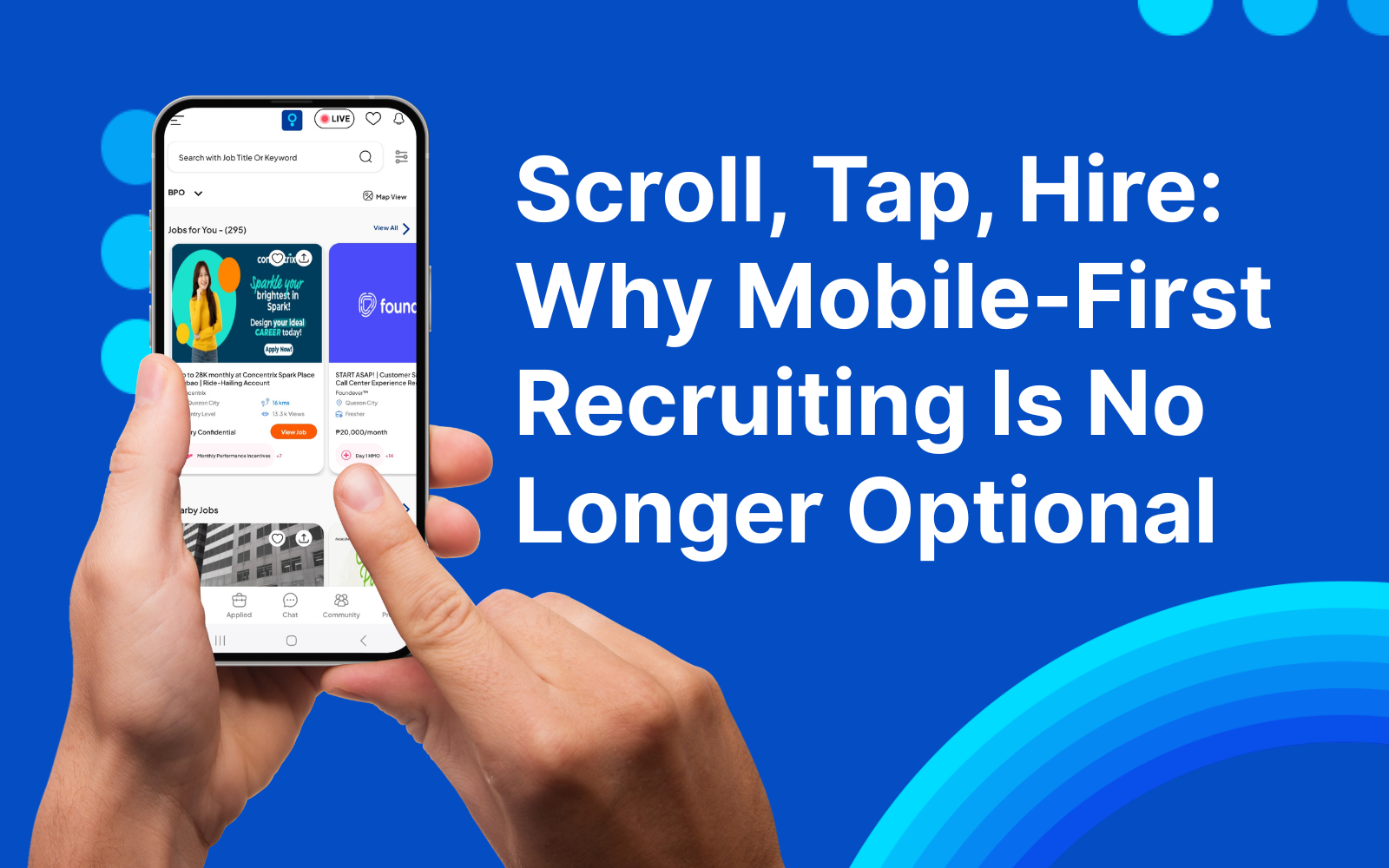
Scroll, Tap, Hire: Why Mobile-First Recruiting Is No Longer Optional
 - (1600 x 1000 px) (10)-148.png)
Unlock more hires: Best practices for posting and optimizing your jobs on Jobyoda

How to Build Effective Campus Recruitment Programs

Best Short Courses That Lead to Jobs in the Philippines


We will validate your hiring details with our partners
and process your voucher shortly

