
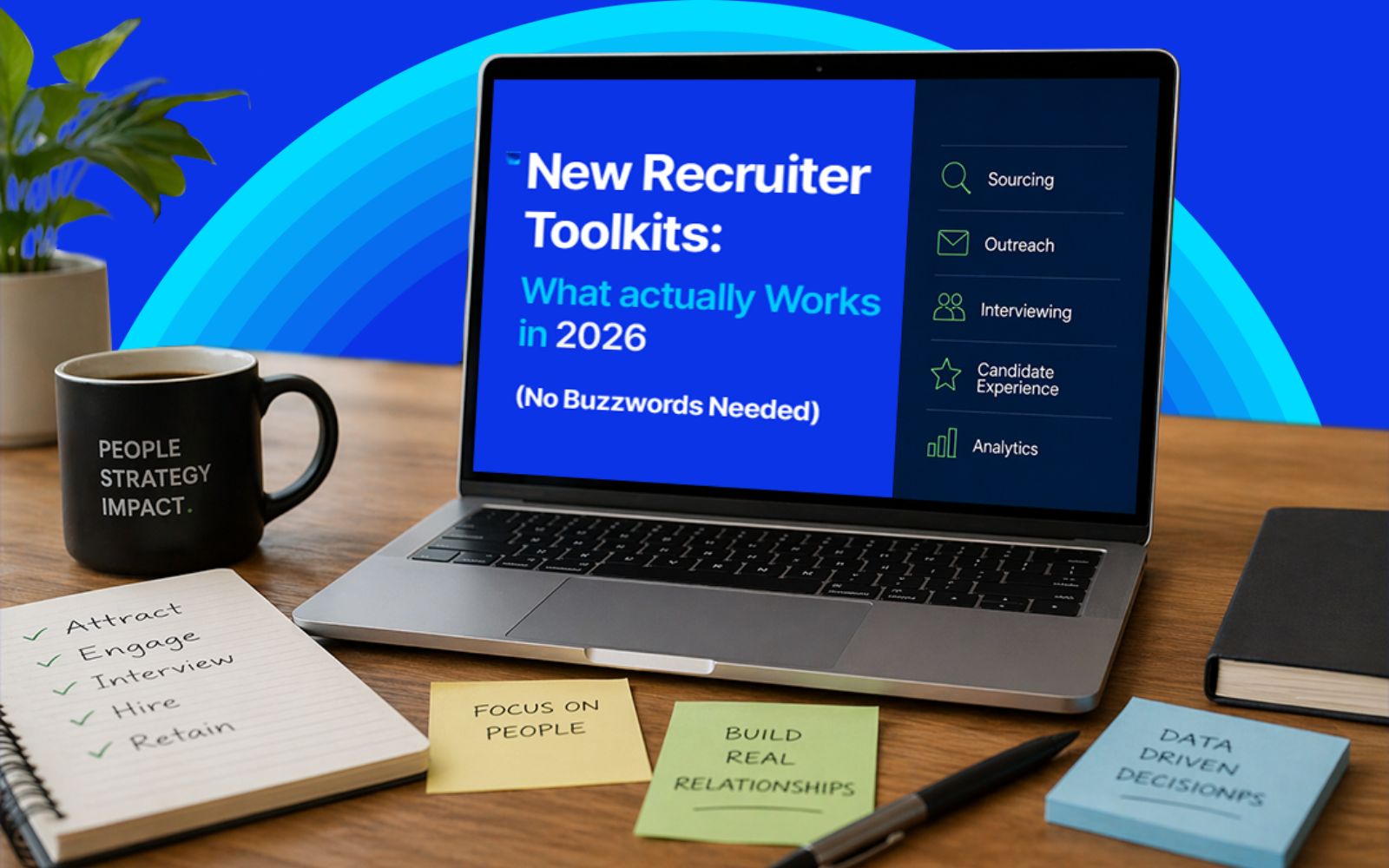
Let me be honest with you, the way a friend who's also your boss would be: most recruiter toolkits out there are either overpriced, overcomplicated, or oversold. And somewhere in between deciphering a 47-step onboarding guide and sitting through your third "transformative AI webinar" of the month, you forgot you just needed to fill three roles by Friday.
This is not that kind of article. No rah-rah AI revolution speech. No listicle of tools that require a $500 monthly subscription, a 3-day implementation timeline, and a dedicated IT person named Gerald to get running. This is a real, grounded, mildly caffeinated breakdown of what actually works right now, in 2026, for Filipino recruiters — especially those grinding in the BPO and shared services space.
Because here is the truth nobody says out loud: the recruiters who are winning right now are not the ones with the flashiest tech stack. They are the ones who picked the right two or three tools, learned them properly, and stopped hoarding browser tabs like it was a competitive sport.
Sabi ng recruiter namin dati: "I use five different platforms." Tanong ko: "Effective ba?" Sagot niya: "Hindi, pero ang dami kong notifications." That is not a strategy. That is a cry for help.
So let us get into it. Here are the recruiter toolkits, habits, and platforms that are actually moving the needle in 2026 — with zero fluff and a healthy amount of tough love, the way you deserve.
Let us start with the obvious one that most people are still getting wrong. A job-hiring platform is not just a bulletin board where you slap a job post and wait. In 2026, if your platform is not actively surfacing your roles to the right candidates, filtering applications intelligently, and giving you usable data on how your postings perform, then you are paying for a billboard on a road that nobody drives through.
The shift you need to make is from passive posting to active sourcing. The best platforms now come with built-in candidate matching, where your role gets pushed to relevant profiles instead of waiting for them to stumble across your listing. They also give you response rate data, average time-to-apply, and drop-off points in your application flow. If your platform does not show you any of that, it is time to have a serious conversation with whoever manages your recruitment budget.
For the local market, this matters even more. Filipino candidates — particularly fresh graduates and mid-career professionals shifting into the BPO industry — are not always actively searching. They are browsing, they are being referred, and sometimes they only apply when a job post lands exactly right in front of them at exactly the right moment. Your platform needs to create that moment, not just host a form.
At Yobi, we have seen firsthand what happens when recruiters use a job hiring platform designed specifically with local hiring behavior in mind. Applications go up. Ghost rates go down. And recruiters stop sending "Hi, are you still interested?" follow-ups into the void at 10 PM. That last one alone is worth everything.
The honest take: a good job-hiring platform should make you feel like you have a team behind you, not like you are shouting into a very organized spreadsheet. If your current one makes you feel like the latter, you already know what to do.
Looking to fill BPO and shared services roles now? Browse active job postings on Yobi
Recruitment automation in the Philippines is having a moment right now, and honestly, it is about time. We have been recruiting in this country for decades with manual shortlisting, manual follow-ups, and copy-pasted job descriptions that have not been updated since 2018. The automation wave is not here to take your job. It is here to take the parts of your job that should not require a human being in the first place.
Let me explain what I mean. When you spend two hours manually emailing candidates to confirm their interview slots, that is not strategic recruitment work. That is admin. And the admin should be automated. When you copy-paste the same rejection message to 80 applicants one by one, that is not personal — that is wasted time. Automate it, write one good template, and spend that hour calling your top three candidates instead.
The smartest deployment of recruitment automation that Philippine recruiters are using right now includes automated scheduling links sent directly after shortlisting, triggered email or SMS sequences for candidate nurturing, and AI-assisted first-round screening for high-volume roles. For BPO companies that hire dozens to hundreds of agents at a time, that last one alone can cut your time-to-hire by more than half.
But here is where I need to give you the tough love part of this section. Automation is only as good as the inputs you give it. If your job description is vague, your ATS screener will pull vague candidates. If your screening questions are generic, your automated filters will let garbage through at scale. Garbage in, garbage out — except now you have a very efficient pipeline full of people who are not a fit.
Take the time to set up your automation properly once. That means writing clear qualification criteria, testing your filters on real applications before going live, and reviewing your automated messages so they sound like they came from a human who respects the candidate's time. Because the worst thing you can do with automation is automate a bad experience at scale.
Naalala ko yung isang recruiter na nag-automate ng rejection emails, pero hindi isinali ang first name field. So everyone received: "Dear [First Name], thank you for applying." Oo, automated. But also deeply, deeply sad. Check your tokens, bes.
For deeper reading on where automation is headed for recruiters in Southeast Asia, LinkedIn's Future of Recruiting report is worth your time. It breaks down which stages of the pipeline are being automated most aggressively and where human judgment still cannot be replaced. Spoiler: the assessment and decision stages still need you. The scheduling and confirmation stages very much do not.
Hiring for talent acquisition or HR roles in BPO? See active HR & recruitment openings on Yobi
The BPO industry in the Philippines is a different animal. If you have never recruited for it, I cannot fully explain to you the combination of volume, urgency, and process compliance it demands. You are hiring for English communication skills, typing speed, night-shift availability, emotional resilience, and technical aptitude simultaneously — often for 50 seats at a time, with a start date two weeks out. If your BPO recruitment tools are not built for that reality, they are working against you.
The tools that are genuinely delivering results right now fall into three categories.
First, there are AI-powered skills assessments that test language proficiency, grammar, comprehension, and cognitive aptitude through adaptive online testing. These have largely replaced the first-round panel interview for many BPO companies because they are faster, more consistent, and cheaper to scale. A candidate completes a 20-minute online assessment at 2 AM from their phone at home, and by the time your recruiter logs in the next morning, there is already a ranked shortlist waiting.
Second, there are video-interviewing tools that enable asynchronous screening. The candidate records responses to pre-set questions, and your team reviews them in batches when convenient. This alone removes the scheduling nightmare of coordinating 40 first-round interviews in a single week. Tools like HireVue, Spark Hire, and some newer Asia-Pacific-specific platforms have made this extremely accessible, even for mid-size companies without a full talent acquisition team.
Third — and this is the one most BPO recruiters underestimate — are candidate relationship management (CRM) tools. Not applicant tracking. CRM. The difference is that an ATS tracks where someone is in your current process. A CRM remembers everyone who ever expressed interest in your company, even if they were not hired last time, even if they withdrew, even if they simply clicked on a job post once and never applied. For the BPO industry, where the same candidate might be hireable six months later when their contract elsewhere ends, having a warm database of past candidates is a genuine competitive advantage.
I once watched a recruiter manually sort through 300 resumes for a single wave of BPO agents. Three hundred. By hand. In Excel. With a highlighter. She was brilliant. She was also visibly exhausted and slightly unhinged by day two. The same task with a proper screening tool would have taken her 45 minutes. I am not saying the tool would have been more human. I am saying she deserved better than a highlighter and a prayer.
For a broader look at how BPO companies in the Philippines are rethinking their hiring process, Business World's coverage on BPO talent challenges gives useful context on the macro pressures reshaping what recruiters in this space need to do differently.
Ready to find BPO talent faster? Post a BPO role on Yobi
Okay, I need to talk about this one because it is the area where I see the most Filipino recruiters underperforming — not because they are not smart, but because nobody ever taught them to think about recruitment as a data exercise.
Most recruiters have data. What they do not have is the habit of looking at it critically and letting it change their behavior. They know their time-to-hire. They know their offer acceptance rate. And then they close the dashboard, go back to sourcing, and do exactly the same thing they did last week. Same strategy, different week, same results, and then everyone wonders why Q3 looks exactly like Q2.
Here is what using data actually looks like when you are doing it properly. You notice that your sourcing on one platform has a 4% application-to-shortlist rate, while another has a 14% rate. You stop splitting your job ad budget equally between the two and put more into the one that performs. You notice that candidates from a specific referral source have a significantly lower 90-day attrition rate. You build a formal employee referral program to generate more of them. You notice that your offer declines spike at a specific point in your process. You investigate and find out your reference check is taking ten days, and candidates are accepting competing offers in the meantime. You fix the process.
None of this requires a PhD in data science. It requires discipline to check your numbers weekly, ask what they are telling you, and make one small adjustment at a time. As SHRM's talent acquisition resources point out, the recruiters who track conversion rates at each stage of their funnel consistently outperform those who measure only final outcomes. Because by the time you see the final number, the chance to fix what caused it is already gone.
Tough love moment: if your quarterly recruitment report is a slide with headcount filled and a bar chart that everyone in the room already knew, you are not doing recruitment analytics. You are decorating. The people in that room should be uncomfortable with at least one number you show them. That is how you know the data is real.
And yes, before you say it: I know your HRIS is limited. I know your ATS does not pull the reports you need. I know your manager does not ask for this level of detail. But the recruiters who are building the case for better tools, bigger budgets, and more headcount are the ones who walk into that room with actual numbers. The ones who do not are still hoping their manager notices how hard they are working. Spoiler: they do not notice. Numbers notice. Numbers talk. Bring numbers.
This is the one that always surprises people when I bring it up in a tools conversation. But hear me out, because in 2026 this might be the highest-leverage thing you can invest in — and it costs nothing except time and the slight discomfort of being visible online.
Candidates research recruiters. Before they respond to your InMail, before they come in for your interview, before they accept your call, they have already looked you up. They have seen your LinkedIn. They have noticed whether you post anything of substance or whether your last activity was a like on someone else's post in 2022. They have read reviews of your company. And if you are a recruiter who has put zero thought into how you show up professionally online, you are starting every candidate interaction at a disadvantage.
Your personal brand as a recruiter is not about being an influencer. It is not about posting daily. It is about being findable, credible, and trustworthy. It means your LinkedIn profile actually says what you do, who you hire for, and why candidates should trust you with their career. It means you occasionally share something useful — an interview tip, a salary insight, a real take on what hiring looks like right now. It means you are the recruiter candidates feel comfortable reaching back out to, even when they are not actively looking, because they know you are real and you actually know your market.
For BPO and shared services recruiters specifically, this is an enormous opportunity because so few people are doing it well. There is a massive audience of Filipino professionals who want honest career guidance, salary benchmarks, and insight into what working at different BPO companies is actually like. If you are the recruiter who provides that, you will never run out of candidates again.
May recruiter akong kilala na nag-post ng "Now hiring! DM me!" nonstop, pero wala namang bio, walang photo, walang kahit anong context sa profile. I love her, but she is not the recruiter you trust with your career. She is the recruiter you think is selling MLM. Mag-update na po ng profile, please.
The LinkedIn Talent Solutions blog on recruiter personal branding has solid, practical advice on where to start. And if you want a local perspective on how Filipino professionals choose who to trust with their job search, Jobstreet Philippines' employer resources section has candidate preference data you should be reading quarterly.
Want to be the recruiter that candidates actually find? Get started as an employer on Yobi
After everything we have covered, here is the honest truth that no tool vendor will put in their pitch deck: the gap between a good recruiter and a great one is not their tech stack. It is their judgment. It is the ability to read a candidate's hesitation over the phone and know what question to ask next. It is knowing when to push harder on a hiring manager who keeps rejecting qualified candidates for vague reasons. It is the instinct to call someone back six months later because something about their profile stuck with you, and knowing that this time the timing is right.
Recruitment automation handles the repetitive. A job-hiring platform handles the distribution. BPO recruitment tools handle the volume. But none of them handle the relationship, the judgment, or the trust. Those are still yours. And in a market where more and more of the process is being automated, those human things become more valuable, not less.
So yes, build your toolkit. Invest in the platforms that save you time. Set up the automations that handle the admin. But do not mistake a faster process for a better one. The goal is not to automate your way to the hire. The goal is to free up enough of your time and mental bandwidth that when a promising candidate lands in front of you, you are present, prepared, and sharp. Because that is what turns a placement into a long-term relationship. And long-term relationships are what build careers — both theirs and yours.
You did not get into recruitment to manage software. You got into it because you are good at people. Use the tools to handle everything else so you can stay good at that.
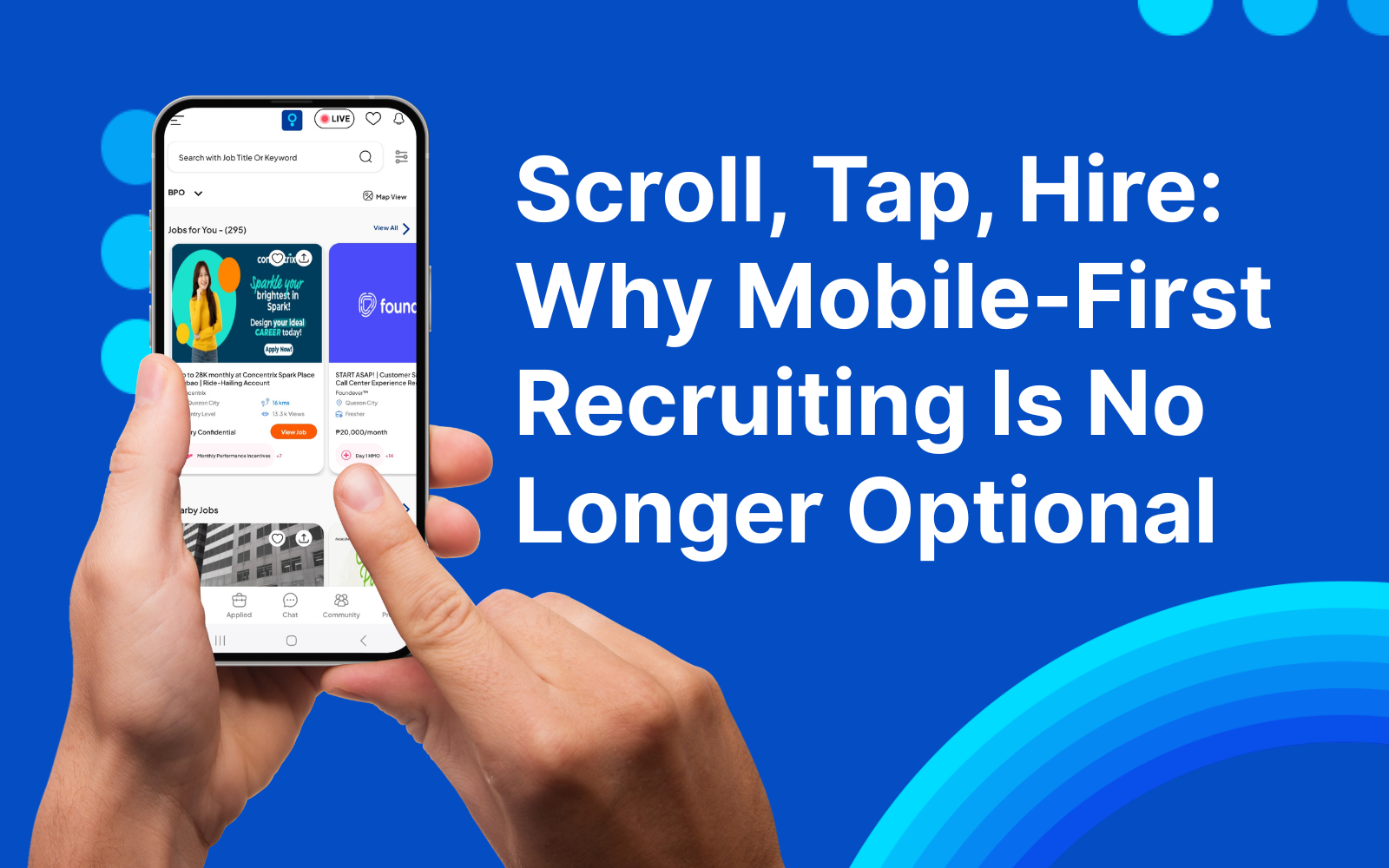
Scroll, Tap, Hire: Why Mobile-First Recruiting Is No Longer Optional
-67.png)
Why your job ads aren't getting applicants in 2026 (and how to fix them)
 - (1600 x 1000 px) (4)-355.png)
A Recruiter’s Guide to No-Experience Roles
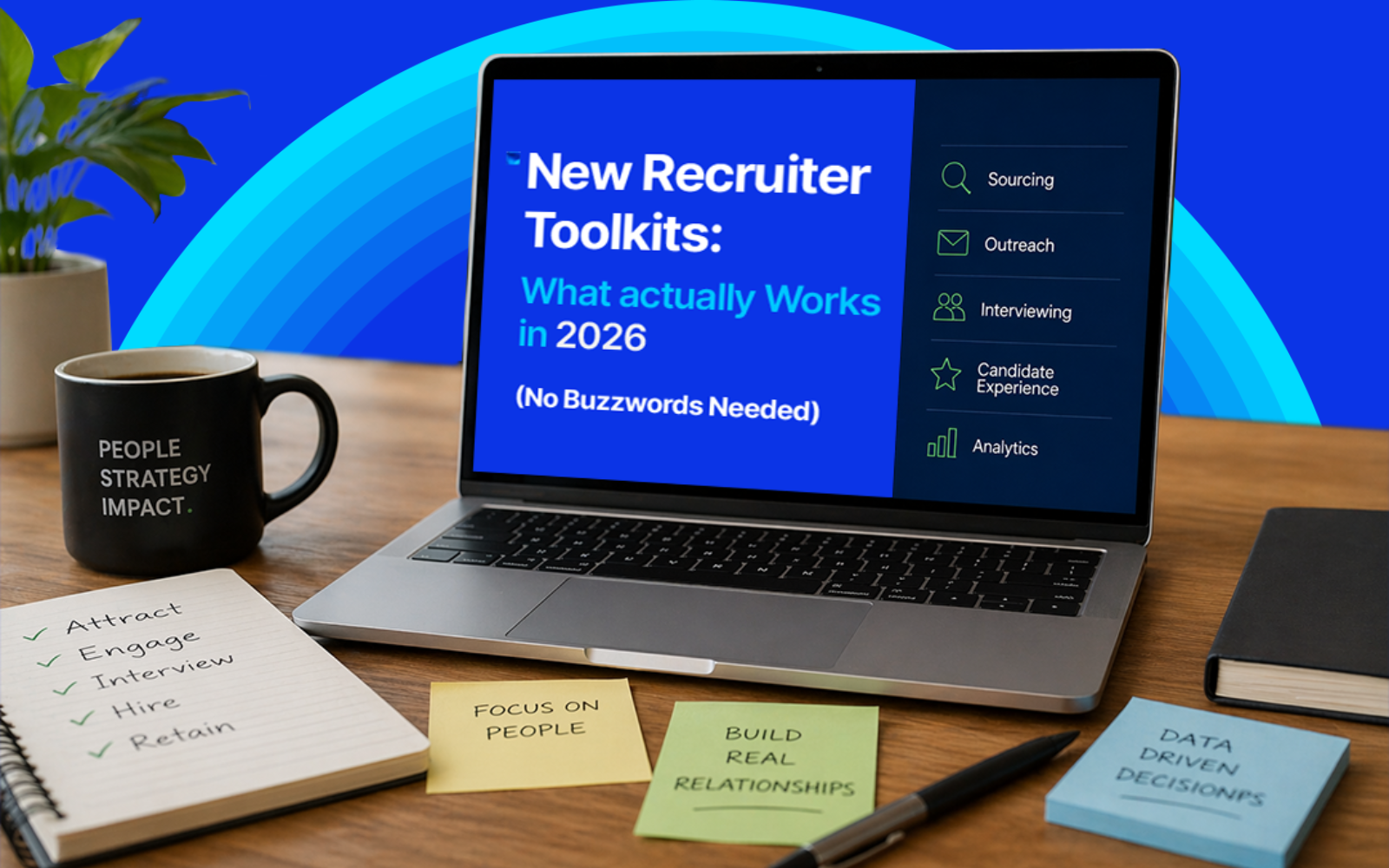
New Recruiter Toolkits: What Actually Works in 2025 (No Buzzwords Needed)

Hiring Gen Z: What Today’s Fresh Grads Want From Employers


We will validate your hiring details with our partners
and process your voucher shortly

